Why We Explode at Family: Buddha's Teaching on Calming Anger Toward Loved Ones
Why do we stay calm at work but explode at family? Discover the Buddha's insights into why anger targets loved ones and learn practices to restore peace at home.
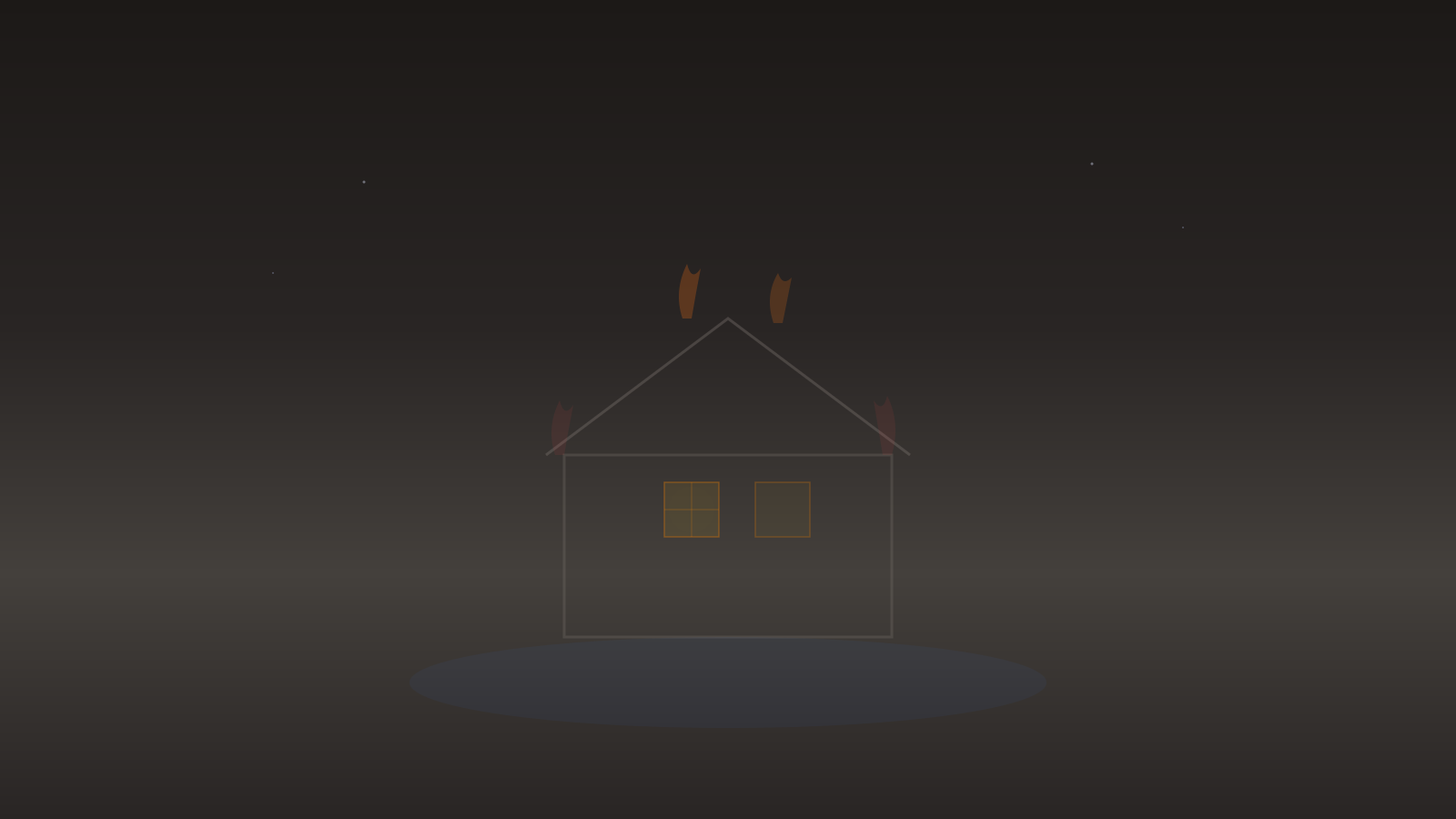
Why Anger Explodes Only at Family
In the Buddha's teaching, the root of anger lies in attachment (upadana). The more deeply we love someone and cling to the relationship, the greater our expectations grow—"They should understand me," "They ought to know what I need." With colleagues at work, we hold modest expectations from the start, making composure easier. But with family, we carry unconscious assumptions like "They should just get it" and "They should anticipate my needs." When these assumptions shatter, the feeling of betrayal transforms into rage.
Furthermore, home is where we remove our emotional armor. The stress and emotions suppressed throughout the day in the outside world erupt all at once in the safety of home. This is what psychology calls "emotional displacement," and it mirrors what the Buddha described as anusaya—latent tendencies sleeping beneath consciousness that surface when conditions are right. The seeds of anger are planted outside but sprout in the safe soil of home.
Consider a concrete example. Suppose your boss criticizes you unfairly at work. You respond calmly: "Understood." But when you get home and your partner simply asks, "What do you want for dinner?" you snap, "Stop asking me everything!" This disproportionate reaction occurs because the unprocessed anger toward your boss has been redirected at your partner—the safe target. The Buddha compared this to fire being carried by the wind to burn in a different place entirely.
The Science Behind Anger Toward Loved Ones
Modern neuroscience confirms the Buddha's insights. Research from the University of Michigan has shown that the amygdala—the brain region governing emotional responses—reacts more intensely toward people with whom we share intimate bonds. In other words, the deeper the attachment, the wider the emotional swings, and this is a natural feature of our brain architecture.
Harvard psychologist Daniel Wegner's research has also demonstrated what he calls "ironic process theory": the more we try to suppress an emotion, the more powerfully it rebounds later. After spending an entire day suppressing anger at work, the backlash erupts at home toward family. This aligns precisely with the Buddha's teaching that suppressed anger does not disappear—it accumulates.
Additionally, attachment theory research at Oxford University has shown that attachment patterns formed in early childhood significantly influence how anger manifests in adult intimate relationships. People with insecure attachment styles tend to overreact toward partners and family members. The Buddha's teaching that past actions (karma) shape our present reactions resonates deeply with these scientific findings.
The Three-Breath Practice for Breaking the Anger Cycle
The Buddha repeatedly taught that when anger arises, rather than reacting immediately, we should pause for a breath. When anger toward family surges, practice these three steps.
With the first breath, simply notice: "I am angry right now." Don't deny the anger—just acknowledge it. At this moment, pay attention to your physical sensations. Are your fists clenched? Are your shoulders raised? Has your breathing become shallow? The body signals anger faster than the mind can recognize it.
With the second breath, ask yourself: "What lies beneath this anger?" Most often, underneath the anger hides sadness from wanting to be understood, or fear of not being valued. For instance, when your child won't listen, the anger may mask anxiety about not being respected as a parent. When your partner seems inattentive, loneliness may be lurking beneath the surface.
With the third breath, consider: "This person is also suffering." Your partner may be exhausted too. Your child may be trying their best in their own way. Your aging parent may be grappling with fears about growing old.
These three breaths interrupt the automatic anger response and activate the circuit of compassion. You don't need to execute this perfectly every time. If you manage to pause even once out of ten times, that represents significant progress.
Practical Strategies for Specific Situations
Anger toward family requires different approaches depending on the situation. Here are three common scenarios with specific practices for each.
First, when an argument with your partner escalates. The Buddha taught that "responding to anger with anger only doubles the anger." When a conflict begins to intensify, calmly say, "I need a moment," and step away. This is not avoidance. A cooling period of fifteen to thirty minutes allows the prefrontal cortex—the brain region governing rational thought—to regain control. Once calm, saying "I went too far earlier. What I was really feeling was..." and honestly sharing your emotions becomes the shortest path to repair.
Second, when your child's behavior triggers frustration. The Buddha taught that "all beings are in the process of growing." When a child repeats the same mistake, instead of demanding "Why can't you do this?" shift your perspective to "What is this child learning right now?" When you feel the urge to yell, first crouch down to your child's eye level and make eye contact before speaking. This physical action alone often transforms the energy of anger into something gentler.
Third, when anger arises in your relationship with your parents. Parent-child anger involves layers of accumulated expectations and disappointments built over many years. The Buddha taught that "clinging to the past is the very cause of suffering." When you feel anger toward a parent, try to see "the parent standing before you right now"—not the parent filtered through decades of memory. When you engage with them as a fellow human being in the present moment, the relationship can begin to shift.
Transforming Your Anger Disposition Through Loving-Kindness Meditation
One of the Buddha's most emphasized practices is loving-kindness meditation (metta bhavana). Rather than merely addressing anger when it arises, this practice gradually transforms the very disposition that makes you anger-prone in the first place.
Here is the specific procedure. Sit comfortably in a quiet place and close your eyes. First, direct wishes toward yourself: "May I be happy. May I be peaceful. May I be healthy." Then, visualize each family member one by one and send them the same wishes: "May they be happy. May they be peaceful."
According to research by Professor Richard Davidson at the University of Wisconsin, subjects who practiced loving-kindness meditation for eight weeks showed a significant reduction in amygdala overreactivity and increased prefrontal cortex activity. In other words, the brain's very response pattern to anger was altered. Just five to ten minutes of daily practice leads to a measurable decrease in anger reactivity.
This practice is particularly effective when you visualize the family member who triggers your anger most frequently and deliberately send them loving-kindness. You may feel resistance at first, but with continued practice, you will notice the hardness in your heart toward that person gradually melting away.
The Art of Repair After Expressing Anger
The Buddha acknowledged that as human beings, completely eliminating anger is extraordinarily difficult. What matters is how we act after anger has been expressed. There are concrete steps for repairing the damage after you have directed anger at a family member.
First, once you have calmed down, go to the person and offer a straightforward apology: "I'm sorry for yelling earlier." Crucially, do not append a justification like "but you started it..." Let the apology stand on its own.
Next, communicate your feelings using "I-statements." Instead of "You are wrong," use "I was feeling..." For example, rather than "I got angry because you never listen," try "I felt lonely when I thought I wasn't being heard." The Buddha's teaching of Right Speech is precisely this—expressing your inner truth honestly, yet in words that do not wound.
Finally, make a specific, actionable commitment to prevent recurrence. "I'll let you know when I'm exhausted before it builds up." "When I feel anger rising, I'll step away and take deep breaths." Even small, achievable promises strengthen the bonds of trust within a family.
Transforming Home into a Place of Practice
The Buddha never considered practice something confined to the monastery. Every moment of daily life is an opportunity for mindful awareness, and family relationships can become the deepest training ground of all—because family members mirror the most tender parts of our hearts.
Each evening, spend just five minutes before bed reflecting on the day's interactions with your family. If there was a moment of anger, quietly observe what was happening in the depths of your heart at that time. Then direct compassion toward yourself. Rather than condemning "the self who got angry," acknowledge "the self who noticed the cause of anger."
Consciously cultivate the habit of saying "thank you" and "I'm sorry" to family members. The Buddha's teaching of Right Speech finds its most powerful application within the home. Reduce one angry word and add one grateful word. This small accumulation fundamentally transforms the atmosphere of a household.
Anger does not vanish in a single day. But by practicing the Buddha's teachings little by little within the fabric of daily life, change will surely come. The very moment you wished to change your pattern of hurting the ones you love most, your practice had already begun.
About the Author
Buddha Teachings Editorial TeamWe share Buddha's timeless teachings in a way that is easy to understand and applicable to modern life.
View author profile →Related Articles
Calming the Mind Through Repetition: The Power of Mantra Meditation as Taught by Buddha
When Kindness Exhausts You: Buddha's Teaching on the Difference Between Compassion and Self-Sacrifice
Awaken Your Mind Through Your Senses: Buddha's Teaching on Sensory Meditation
What If I Had Chosen Differently? Buddha's Wisdom on Forgiving Your Past Decisions